For more than a decade, building a new coal-fired power plant in the United States looked politically, financially, and environmentally impossible. Coal was treated as a fuel of the past: too dirty, too controversial, and too exposed to regulation.
But the explosive growth of artificial intelligence and data centers may be changing that calculation.
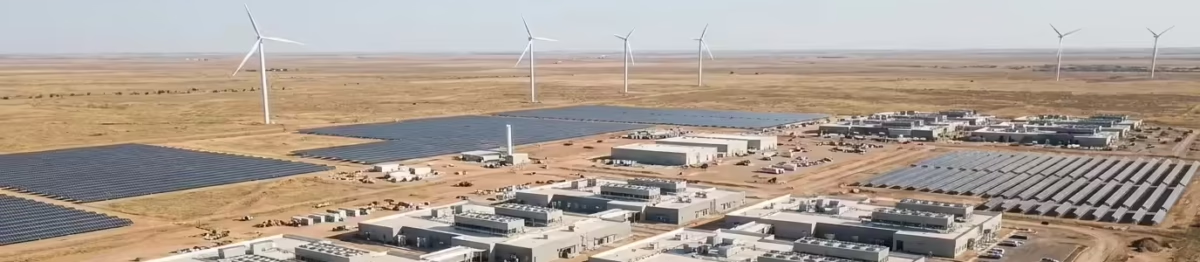
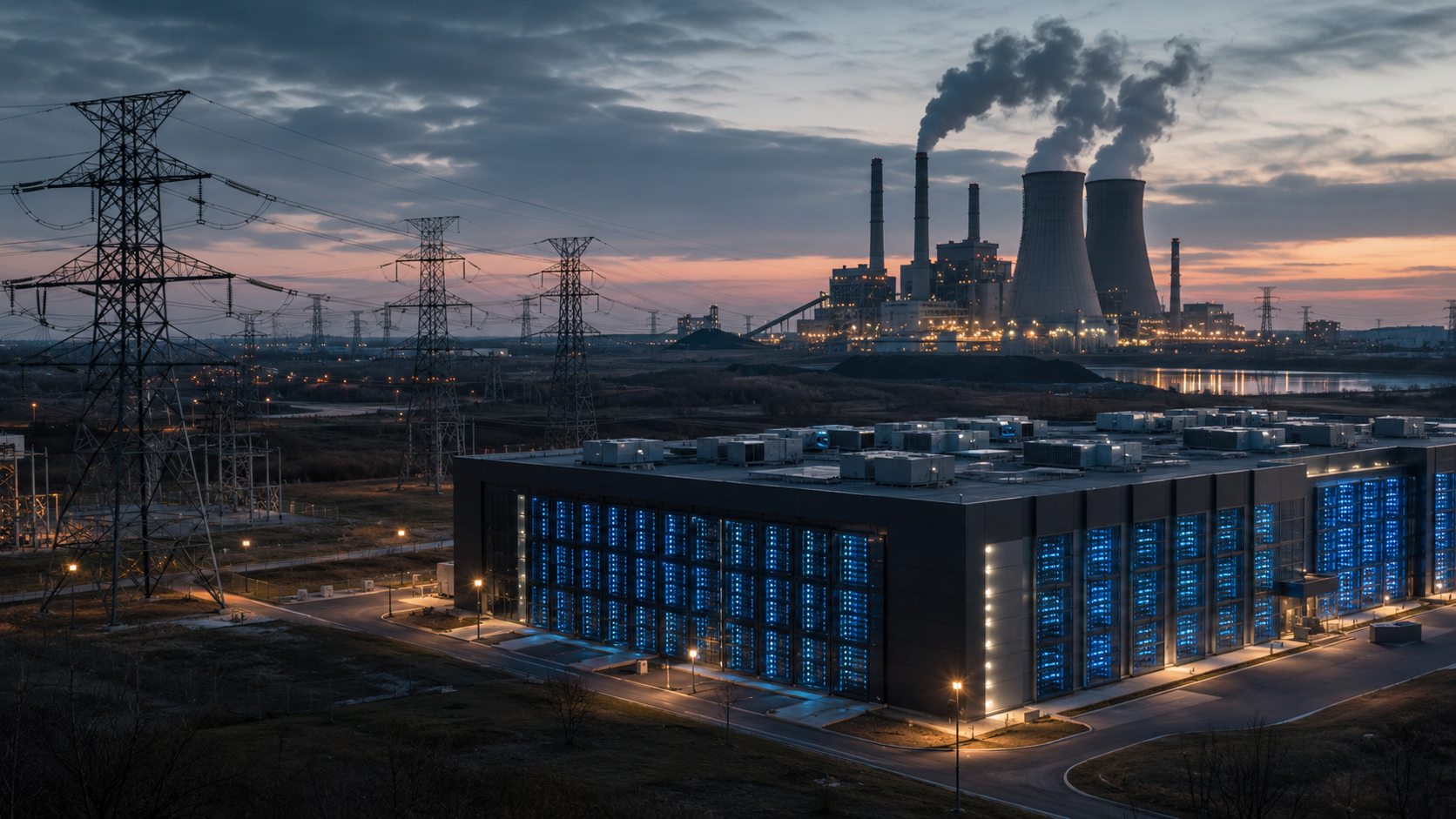
The uncomfortable truth is simple: AI does not run on slogans. It runs on electricity. Vast, constant, reliable electricity. Every new hyperscale data center, every AI training cluster, every cloud-computing expansion adds another heavy load to a grid that is already under pressure from electrification, industrial reshoring, transmission constraints, and the retirement of older power plants.
This is why a new coal project in West Virginia, once almost unthinkable, is suddenly being discussed seriously.
The proposed TerraSpark Energy Campus would be a 1.6-GW greenfield coal plant using four 400-MW supercritical coal units. It would be paired from the start with carbon-capture technology, rather than treating emissions control as an afterthought. The project has received early-stage support from the U.S. Department of Energy for engineering, permitting, and technical studies.
That does not mean the plant will definitely be built. Far from it. The hard questions remain: total cost, financing, long-term customers, permitting, carbon-storage execution, and whether the carbon-capture technology can scale economically. But the fact that such a project is even moving through the development pipeline is significant.
It tells us something important about the new energy reality.
For years, policymakers assumed that coal could be retired while renewables, batteries, gas, nuclear, and transmission upgrades would fill the gap. In theory, that transition looked manageable. In practice, demand is now rising faster than many expected. AI has accelerated the problem. Data centers do not consume electricity like ordinary commercial buildings. They require huge amounts of power, often around the clock, and they demand reliability. A few hours of instability is not an inconvenience; it is a business risk.
That is where coal re-enters the discussion.
Coal’s great weakness is emissions. Its great strength is dispatchability. A coal plant can provide firm power day and night, regardless of weather, time of day, or battery duration. For grid planners and industrial users facing large, constant loads, that reliability still has value.
The new political language around coal is no longer simply “bring back the past.” It is being reframed as “firm power,” “energy security,” “industrial competitiveness,” and “baseload generation for AI and manufacturing.” Add carbon capture to the proposal, and developers can argue that modern coal may have a place in a lower-carbon grid, especially where power demand is rising faster than clean alternatives can be deployed.
Whether that argument succeeds is another matter.
The memory of failed or over-budget coal-with-capture projects still hangs over the sector. Investors will not fund nostalgia. They will want numbers. They will want contracted customers. They will want proof that carbon capture can work at scale, at acceptable cost, and without turning the plant into another expensive experiment.
But the bigger point is this: AI may be forcing the energy debate back toward realism.
A country cannot simultaneously demand rapid electrification, massive AI infrastructure, reshored manufacturing, domestic energy security, and the retirement of firm generation without replacing that capacity with something equally reliable. Wind and solar will remain important. Gas will likely continue to grow. Nuclear may become essential again. Batteries will help. But none of these options can be built instantly or everywhere.
That is why coal, once written off, may find a narrow but renewed opening.
Not as the old coal of the 20th century. Not as an unlimited comeback. But as part of a hard-nosed discussion about how to power an AI-driven economy that is consuming electricity at a scale few politicians seemed ready to confront.
The irony is striking. The technology sector, often presented as clean, modern, and futuristic, may end up creating demand for some of the oldest forms of firm power. AI may be digital, but its appetite is brutally physical: land, chips, cooling systems, transmission lines, transformers, and power plants.
The question is no longer whether coal is popular. It is whether the grid can meet the next wave of demand without keeping every dispatchable option on the table.
For years, a new coal plant in America sounded impossible.
Thanks to AI, it may now be a strong maybe.