
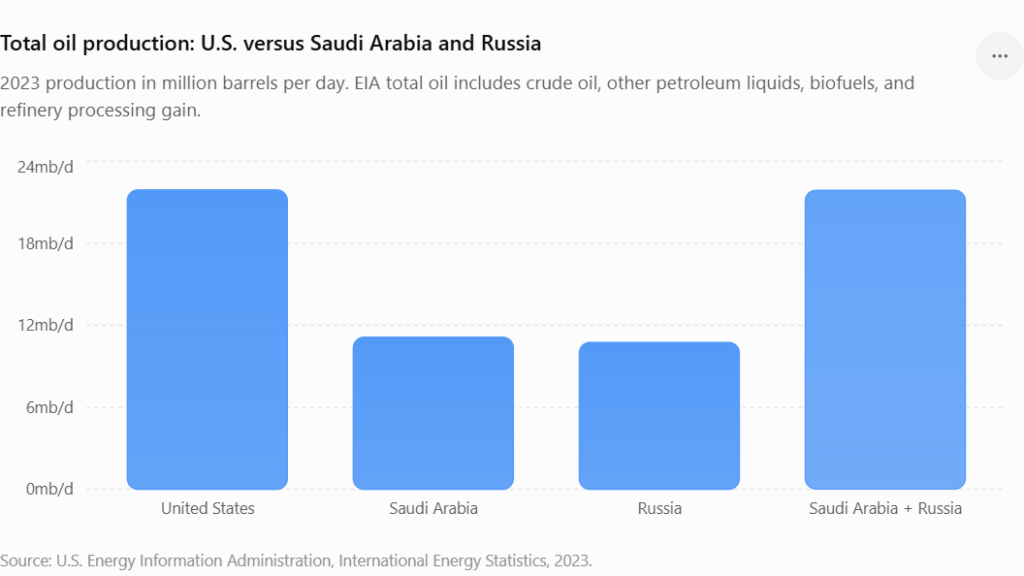
The United States is no longer simply one of the world’s major oil producers. It is the world’s dominant producer. According to public data from the U.S. Energy Information Administration, the United States produced 21.91 million barrels per day of total oil in 2023. That was more than Saudi Arabia at 11.13 million barrels per day and Russia at 10.75 million barrels per day. Remarkably, on this broad “total oil” measure, U.S. production was even slightly higher than Saudi Arabia and Russia combined.
This matters because it changes the way energy security is discussed. For decades, global oil power was associated mainly with the Middle East and Russia. Today, the United States has become the central player in global liquid fuels supply.
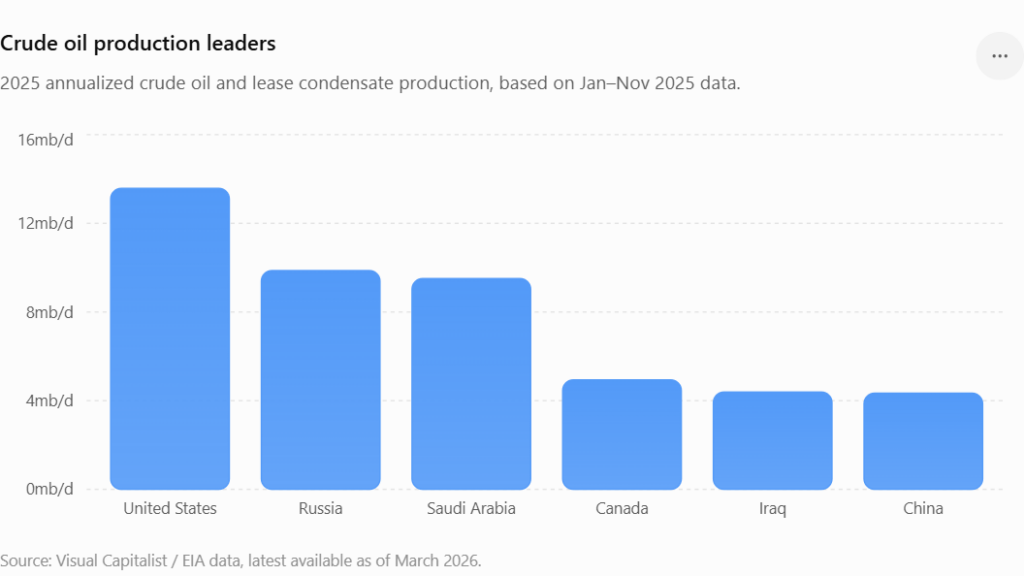
The picture is slightly different when looking only at crude oil and lease condensate. On that narrower measure, the U.S. still leads each country individually, but not Saudi Arabia and Russia combined. In 2025, the U.S. produced around 13.58 million barrels per day of crude oil and condensate, ahead of Russia at 9.87 million barrels per day and Saudi Arabia at 9.51 million barrels per day.
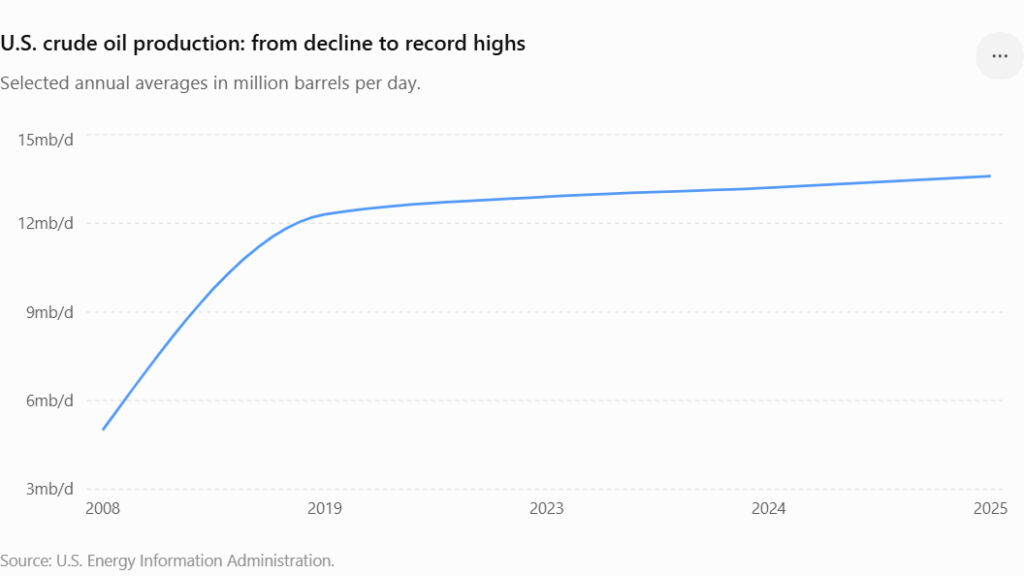
The scale of the change is striking. U.S. crude oil production fell to around 5 million barrels per day in 2008, before the shale revolution transformed the sector. Horizontal drilling, hydraulic fracturing, and the rise of the Permian Basin helped push American output to successive records. By 2025, U.S. crude production had reached 13.6 million barrels per day, a new annual record.
This production strength is also relevant to the current debate around data centers, artificial intelligence, and electricity demand. Large data centers are often presented as clean-energy projects when they are connected to wind, solar, and batteries. But reliability still matters. When power must be available continuously, traditional energy sources remain central to the equation.
That is why projects such as Google’s Meitner Energy Center in the Texas Panhandle are important. They show the emerging model clearly: renewable generation and battery storage are used to reduce emissions and grid pressure, while on-site gas-fired generation provides firm, dispatchable power when needed.
The broader American energy picture helps explain why this model is attractive. The U.S. has become a huge producer of oil and natural gas, and regions such as Texas benefit from abundant nearby hydrocarbon resources. For large industrial power users, including data centers, access to reliable and relatively cheap gas remains a major advantage.
The conclusion is simple: the U.S. energy story is not only about renewables. It is also about scale, fossil fuel abundance, and reliability. America’s oil and gas production gives it a strategic advantage that Saudi Arabia and Russia no longer dominate in the same way.
Key source notes: EIA’s FAQ gives the 2023 total oil production ranking and explains that “oil” includes crude oil, other petroleum liquids, biofuels, and refinery processing gain. EIA also says U.S. crude oil plus condensate averaged 12.9 million b/d in 2023, broke the prior U.S. and global record, and that U.S. crude output recovered from a 2008 low of 5.0 million b/d. EIA reported U.S. crude oil production at a record 13.2 million b/d in 2024 and 13.6 million b/d in 2025. The 2025 international crude ranking shown in Graph 2 is based on Visual Capitalist’s EIA-derived Jan–Nov 2025 annualized data.